

At the edge of a winding road stands a banyan tree, its roots sinking deep into the soil, its aerial strands swaying like threads of time. In the heart of the village, another banyan grows from an old stone platform, the circular seat around it now cracked with age. Nobody remembers who first planted them, yet they feel eternal – trees that have quietly stood while everything else has changed.
When the first families built their homes nearby, the banyans were already tall. Children clambered over their roots, their laughter echoing in the shade. Farmers, weary from the fields, rested beneath their canopy, placing sickles and grain bundles at their feet. Travellers paused under the roadside banyan during scorching summers, wiping the sweat from their brows, thankful for the cool shelter the leaves provided. Goats and cattle found refuge there, too, chewing calmly in the shade while the heat burned all around.
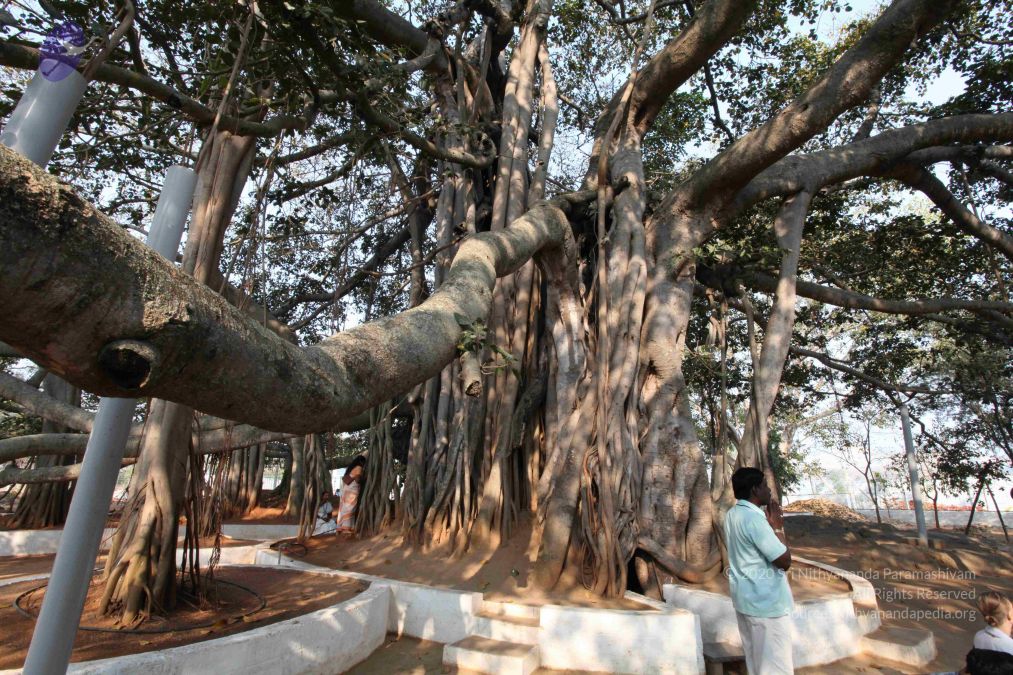 (Image by Nithyanandapedia)
As the years passed, the banyans thickened with memory. The one in the village square became the centre of community life. Men gathered there in the evenings, playing cards or discussing harvests. Elders told stories of the past, their voices mingling with the rustle of leaves. Festivals were held beneath its branches, lamps glowing at its roots as prayers were offered for rain, for health, for good fortune. The stone platform, though now crumbling, still carries the echoes of laughter, quarrels, and quiet moments of rest.
The roadside banyan became a silent witness to change. It saw bullock carts give way to bicycles, and bicycles replaced by motorcycles. The narrow path turned into a tarred road, carrying trucks and buses that roared past. Houses around the trees slowly transformed—where once stood simple mud huts with thatched roofs, now brick and cement walls rose, some painted brightly, others left bare. With these changes came new residents: some families moved away in search of opportunities in cities, while others arrived, building new homes nearby, carrying their own dreams and struggles into the village.
The banyans also saw the struggles of the people who lived around them. There were years when jobs were scarce, when men wandered far in search of daily wages, and families worried over empty kitchens. Illness swept through at times, testing the strength of the villagers, and yet they endured, caring for one another in the banyan’s shade. Quarrels and disputes flared—over land, over water, over survival—but eventually, life found balance again, and people rebuilt what was broken. Just as the banyans held strong against storms, the villagers too found resilience, standing back up after every fall.
Through every season, the trees endured. They bent in heavy rains, shook under strong winds, and drooped in the blazing summers when the air itself seemed to tremble. Over time, the climate itself shifted—summers became hotter and longer, the rains more uncertain, arriving late or flooding heavily. Crops suffered, farmers worried, and the banyans stood silent through it all, watching both the despair and the determination of the people who refused to give up. Yet each spring, the trees pushed out fresh green shoots, as if to whisper that life continues, that hope should not be abandoned.
Generations grew beneath them. Children who once swung from their roots brought their own children years later, pointing and saying, “This was where I played.” The banyans were there at every turn—when a newborn was carried home, when a wedding procession passed, when villagers gathered in grief after a loss. They held all of it in silence, their trunks becoming living archives of time.
Today, when people pass by, they may not always stop, but they feel the presence of these trees. The cracked platform, the wide shade, the roots tangled in the soil—each speaks of continuity. To the villagers, the banyans are not just trees. They are companions, guardians, and keepers of memory.
They have seen lives begin and end, seen happiness and struggle, seen mud houses turn to brick walls, seen residents arrive and depart, seen climate shift and summers grow harsher. And still, they remain—steady, patient, waiting for the next child to climb their branches, the next traveller to rest in their shade.
The banyans have no voice, yet they tell the longest story of all. They are living memoirs, standing strong as generations pass, carrying the history of the place in their silent heart.
About the Author: Sylva Lumen is a nature conservationist and storyteller. The author finds unique comfort beneath old trees. Their writings reflect a deep pull towards these silent keepers of memories.