

Organising a nature walk may seem straightforward—find a forest trail, and a group of enthusiastic participants will readily follow. However, the experience changes in an urban setting. City life moves at a faster pace, and places with rich tree diversity are often located on the city’s fringes, making early-morning access difficult for many. Fortunately, community gardens nestled within the city offer an alternative. Despite manicured lawns and ornamental plantings, many of these spaces still retain pockets of their original plant diversity. It was at this point, after much deliberation, that I decided to conduct my first SeasonWatch Walk—at the familiar Hanging Gardens of Mumbai.
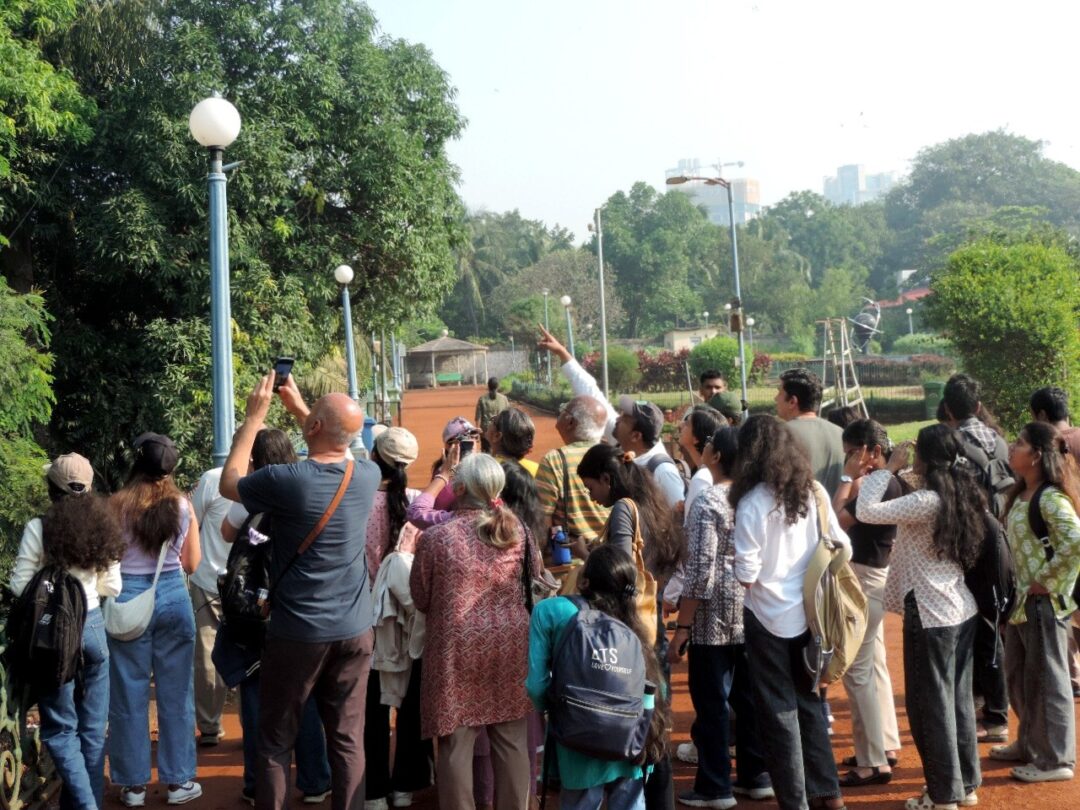
Enthusiastic participants observing the flowers and pollinators on a tree
Preparation for the tree walk began nearly two weeks before the event, with a couple of reconnaissance visits to the site. These visits were essential to understand the landscape in its current state—identifying trees in flower or fruit, noticing familiar plants, and shaping a trail that allowed slow observation without interfering with regular park users. Paying attention to these small but important details helped determine not just the route and timing, but also the themes and examples that could naturally unfold during the walk. The idea was to leave room for curiosity to emerge, allowing questions to guide the experience, instead of following a scripted tour with a guide. Registration opened a few days before the walk and filled up rapidly, reflecting strong interest in nature-based activities—especially since similar events had not been organised in the area for a long time. Simple tools such as voluntary WhatsApp polls helped participants start thinking about trees even before the walk began, creating a sense of anticipation for observation and learning. Social media promotion also proved invaluable, helping reach a wider audience and attracting genuinely interested participants.
On the day of the walk, 37 participants finally joined, ranging in age from young students to senior citizens. Seasoned participants were particularly excited, asking frequent questions, sharing observations, and contributing to thoughtful discussions. Their prior knowledge and occasional differing viewpoints led to healthy exchanges that enriched the walk. Students, on the other hand, appeared somewhat reserved at first, perhaps unfamiliar with this kind of outdoor learning. As the walk progressed, everyone slowly began to notice patterns—canopy structure, leaf shapes, flowering stages, and the presence of pollinators. Together, we recorded 54 plant species, including 30 trees listed under seasonal monitoring, along with several common garden shrubs. To ensure no one felt left behind, an additional 15-minute recap session was held after the walk to revisit key ideas and clarify concepts. This informal discussion helped bridge gaps in understanding and gave quieter participants a comfortable space to ask questions.
Overall, the walk proved to be a memorable experience for the group, reflected in the positive and reassuring feedback received. It reaffirmed that many people are eager to reconnect with urban nature when given the opportunity and gentle guidance. Above all, the experience reinforced a simple truth: a tree walk is not just about identifying species, but about slowing down, observing closely, and rekindling the joy of understanding nature within everyday urban spaces.
Acknowledgement: Deeply grateful to our collaborators; the Save Hanging Garden group (@save.hanging.gardens) and the SeasonWatch team, especially Ms. Sayee Girdhari (Coordinator SW) for their immense support in promotion, encouragement, and providing clear guidelines for the program, all of which contributed to making the walk a success.
About the author: Gaurav is a Mumbai based naturalist working towards urban wildlife conservation using citizen Science tools. Through his self-supported project ‘Butterflies of Mulund, (@butterfliesofmulund), he continues to document local pollinator diversity, often creating awareness through nature walks and educational content.



So refreshing to read about tree walks! I really enjoyed the bit about students getting to experience this kind of outdoor learning. This helps them connect with nature more. The more the adults take interest in nature activities, the more the children will learn. Thank you for sharing this information, looking forward to more such experiences.